
A podcast where we share stories of hope for family caregivers breaking through loneliness to see God even in this season of life.

Stories of Hope for living content, loving well, and caring with no regrets!

Episode 253
She talks through why caregiving so often creates mixed emotions you can’t neatly resolve. You can be thankful and tired. You can love your person and still feel overwhelmed by dementia behaviors, medical needs, family dynamics, and the constant mental load. Rayna shares a simple framework that’s been surprisingly helpful: “yes, and.” “Yes” names what’s real without minimizing it. “And” asks what else is also true, so the hard doesn’t become the only thing you can see.
Along the way, we explore how stress puts us into problem-scanning mode, why that’s normal, and how gratitude can widen the lens for your mental health and your faith without forcing cheerfulness. You’ll hear practical, real-life caregiver examples, including small insights that reduce stress and help you notice progress, kindness, and God’s daily provision.
If you need a gentle way to practice this, Rayna also shares her Honest Gratitude Resource, a seven-day email series designed for caregivers who want gratitude that doesn’t feel fake.
No Regrets: Hope for Your Caregiving Season
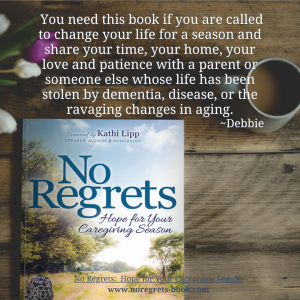
As people age, so do their loved ones. The healthy integration of caring for an aging parent requires being able to walk them all the way to the end of their life while still having a life to walk back into. No Regrets helps caregivers consider how being intentional in their season of caring will allow them to care for their loved one well while at the same time not losing themselves in the caring.
Transcript
*Transcript is an actual recount of the live conversation
When Gratitude Feels Complicated
Rayna Neises 0:02
Welcome to A Season of Caring Podcast, where we share stories of hope for family caregivers, breaking through the busyness and loneliness of caregiving to find hope. I'm Rayna Neises, your host, and I'm really glad that you're joining me here today Today I wanna talk about gratitude, and it's not the easy kind. I wanna talk about what gratitude looks like when life is heavy, when caregiving is stretching you thin, and when all the messages this time of year are about being thankful, and you just don't feel like it's that simple. Because if we're honest, gratitude, it can be complicated, especially during a caregiving season. This time of year we start hearing everywhere, "Be thankful. Count your blessings. Focus on the good. Choose gratitude." And listen, I believe gratitude matters. I really do. I've seen the way that it changes our perspective. I've seen the way that it helps us notice God's presence for sure. And I've seen That it impacts our emotional health. But I also know that when you're in the middle of caregiving, gratitude can feel like one more thing that you're supposed to do. And if your heart feels tired and your loved one is declining, or you're in the middle of a crisis, even just family dynamics are hard, the holidays highlight what has changed instead of what is sparkling and joyful. And when all that talk about Thanksgiving can start to feel more like pressure than peace, ugh. That's why I wanted to have this conversation with you. I wanna talk about what I'm calling honest gratitude. Not pretending, not polished gratitude, But the kind that skips over the ache and rushes straight to the lesson. I mean the kind of gratitude that makes room for truth, that lets grace and grief sit in the same room. The kind that says, "This is hard, and there is still something here I don't wanna miss." That's where this little phrase, "yes, and," has become
Yes And For Real Life
Rayna Neises 2:15
so helpful to me. Now, I have to smile when I say that because this idea came from improv. And let me tell you, I would never do improv. I really don't think that it's my kind of brave. You know, standing in front of a group of people with no script, no notes, and no idea what somebody else is gonna throw at me in the next few moments sounds completely terrifying to me. So that is not the growth experience that I'm looking for. But the idea behind it is so helpful. In improv, if someone introduces something unexpected into a scene, you don't shut it down. You don't say no. You accept what's there with yes, and then you add to it, and you don't pretend that something different is happening. You're not like a politician who doesn't answer the question. You respond to what is actually in front of you. And the more I thought about that, the more I realized caregivers are doing some version of that all the time because caregiving can really feel unscripted Most of us didn't step into this season with a neat plan and a clear map. We had other ideas about how life was gonna go, and there were expectations that we didn't realize we're carrying until caregiving, frankly, interrupted them. Maybe you thought the holidays would still look the same. Maybe you thought retirement would be completely different. Or even you assumed that your parents would always be the one hosting the holidays. Maybe you thought your spouse would be sitting across from you in health for many, many more years. Maybe you pictured this stage of your life with freedom and more flexibility, more just ease even. And then caregiving arrived either suddenly or slowly, and what once felt familiar, it started to shift. And that's
Holidays Put Change On Display
Rayna Neises 4:20
one reason this season can be so tender. Holidays have a way of putting a spotlight on change. They remind us what used to be easy, they remind us who used to do what, and they remind us of traditions that no longer fit, conversations that no longer happen, and even energy that simply we just don't have anymore. For caregivers, Thanksgiving can be a mixed pot, not just a meal It might be managing medications in the middle of family time. It might be trying to keep mom calm in a noisy house. It might be wondering if dad can handle the trip. It might be cutting food into small bites while everyone else is talking and laughing. Even cleaning up an accident before dessert. Or carrying the emotional labor of making it all happen while everyone around you says, "Isn't this nice?" And maybe it is nice, and maybe it is really hard. That right there is the heart of this conversation. There are so many moments in caregiving where two things are true at the same time. You can be thankful and tired. You can be grateful your loved one is still here and grieve how much things have changed. you can love someone deeply and feel overwhelmed by what their care requires. And you can recognize God's faithfulness and still feel sad, stretched, frustrated even, or even numb. Those things don't cancel each other out. I think it's important because a lot of caregivers quietly assume that gratitude is real and the harder emotions should just disappear. I think that's important because a lot of caregivers, people quietly assume that if gratitude is real, the harder emotions should just disappear. If I were more faithful, I wouldn't feel this conflict. Maybe if I were more thankful, I wouldn't feel sad. Or if I was doing better spiritually, I wouldn't feel irritated, disappointed, or even worn down by the very people that I love so much. But caregiving and life doesn't work that way. And honestly, being human doesn't work that way either. The truth is conflicting feelings can live side by side. That doesn't mean you're doing it wrong. It means that you're paying attention. It means that you're telling the truth. Honest gratitude, it starts right there in that place. It doesn't ask you to deny what's hurting. It doesn't ask you to minimize the losses or the changes, nor does it demand that you tidy everything up before you bring it to God. Honest gratitude simply refuses to let the hard places be the only thing that you see.
Gratitude That Widens Your Lens
Rayna Neises 7:40
And that matters because caregiving has a way of narrowing our focus. When we're stressed, our mind literally is designed to constantly scanning for what needs attention. What did I forget? when's the next appointment? Did I refill the medication? Why is he more confused today than he was yesterday? Is she eating enough? And what do I need to do about the guests that are coming? And how am I gonna manage this conversation with my siblings? And what happens if things get worse over the holiday weekend? Yes, all those thoughts, they all happen. They happen to all of us. That kind of pressure changes the way that we see the world. Our brain, it's trained to look for problems because there are real problems to solve, and it wants to solve them. So that is not a character flaw. That is part of survival in this very demanding season. So when problem scanning becomes our only mode, we start missing the other parts of reality. We miss help. We miss beauty. We miss progress. We miss the kindness, even the little graces that are still there, not because life is easy, but because God is good, and He has not left us alone. That's one reason that gratitude is so powerful. It widens our lens, not by pretending the heart isn't there, not by talking ourselves out of reality, but by helping us see more of reality. That's why I like this phrase, yes, and. Yes, this season is hard, and there is still grace here. Yes, I miss how things used to be, and I am grateful for this moment in front of me. Yes, I am carrying a lot, and I can see ways that God is sustaining me. Yes, the holidays feel different, and there may still be some sweetness tucked inside of them. To me, that feels so much more honest than trying to force a big feeling of thankfulness when it just isn't there, and I think caregivers need honest tools. We don't need one more message that leaves us feeling like we're failing. We need language that helps us to tell the truth
The Drive Home Reflection Practice
Rayna Neises 10:15
and stay open to grace at the same time. As I was thinking about this, I kept remembering those long drives home after caring for Dad. I've shared before that I drove 220 miles from the farm to Dad's house, and I stayed three days a week during that part of my season. Those drives became a part of my caregiving. Obviously, they took a lot of my time, but they became a place of reflection. They were a place where I processed what had happened those three days that I was there, what was working, what wasn't working, what had changed, and what I might need to do differently for the next weekend. I wasn't sitting there pretending those days were easy. No, I certainly wasn't. Many times there were tears, but there were weekends that left me totally worn out. There were moments that left me feeling so frustrated, and then there were those times of just heartbreak. Moments that brought up grief in a fresh, new way. There were times when I drove home feeling the weight of all the changes and all that I just couldn't fix, but I also learned not to stop there. As I replayed the weekend, other things would come into view, a moment when Dad smiled or when he hit the ping pong ball all the way down the hall again. A strategy that worked better than it had before, a conversation that gave me insight, lunch with my sister where we actually laughed, a practical adjustment that made the next step a little clearer, or even a reminder that I'd handled something better than I might have earlier in the season. That mattered, not because it erased the hard, but because it kept me from being swallowed by it, and I think many caregivers need that reminder this time of year. Just because the hard is loud does not mean it's the only thing that's true There's another lesson like this that I kind of wanted to put this in perspective of.
The Ball Cap Clue
Rayna Neises 12:30
So my dad wasn't one that said frequently, "I need to go home," or that wanted to leave very often. The other caregivers seemed to be having a little more problems with that than I was, but at times I would see that. And I started to realize that when Dad put his ball cap on, he was leaving. He always wore his ball cap when he left, and so it had been sitting on the back of the couch right by the door that led to the basement that went to the garage that led to outside. And when he put that ball cap on, he was leaving, and you really were not gonna talk him out of it. Now, I didn't try a lot. Now, at 10:00 at night, I might try, but I didn't try a lot to talk him out of it. I would rather go with him, but the caregivers often found themselves dealing with this and being very frustrated by it. And if I had only focused on the frustration of him wanting to leave or wanting to go home when he was home, then I would have missed it. I would have missed the signs and the moments that would have helped me to understand better what was happening. Reflection helped me see that pattern, and once I saw the pattern of the ball cap going on the head, I could do something about it, and that was just as simple as putting the ball cap downstairs on a hook right by the door when we actually were leaving, not putting it somewhere where he would see when we weren't leaving. And so that time of being able to say, "What's causing this? Why is he doing this? How do I change this?" All of those questions led me to finding a solution, something that really did work for us. So figuring out how I could respond differently, that's gratitude too, though not in the way that people often talk about it. It wasn't this big emotional moment, "I'm so thankful for..." It was quieter than that. It was the gratitude of growing and understanding, the gratitude of insight, oh, so thankful for that, and the gratitude for one less mystery, right? Seeing that even that confusion, there was a clue, there was a lesson, there was a way forward to alleviate that stress for him and for us. Caregiving is full of small things like that, a calmer morning, a better response, a meal that they actually enjoy, a helpful nurse, even family members who just show up, medication adjustments that have made the day more manageable, a memory that surfaced and made everyone laugh, a few peaceful moments on the porch, or the fact that you made it through the day that you were not sure that you were going to. Those things, they do not look dramatic from the outside, but gosh, they matter. They're a part of the whole picture, and gratitude helps us to notice them. Now, I wanna be careful here
Honest Gratitude Is Not A Spin
Rayna Neises 15:40
because honest gratitude is not the same as putting a positive spin on everything. It's not saying, "Well, at least," every time the pain shows up. It's not rushing people past the grief, and it's not spiritual bypassing where we use nice words to avoid real emotions It's even not silencing yourself when you need to admit that something is broken, unfair, or exhausting, and even deeply sad. In fact, I would say honest gratitude requires honesty first. It begins with naming what's real. This is hard. I'm sad. I'm disappointed, overwhelmed. I miss what I used to be. I wish that looked different, or I'm struggling to feel thankful right now. That kind of truth-telling is healthy. It's humbling. It opens doors for us to receive care instead of pretending that we're above it Then comes the and. And what else is true? That question is simple, but it opens things up. And what else is true here? Maybe what's also true is that a friend texted at the right time. What's also true is that your loved one had one really good hour today. Maybe what's also true is that you made a hard phone call that you've been dreading Or also that God gave you enough strength for what was right in front of you. Or maybe that there was beauty outside of your kitchen window while you did the dishes. Maybe what's also true is that this Thanksgiving meal looked nothing like it used to, and there is still love around the table. That is honest gratitude. It doesn't force gratitude into the wrong place. It lets gratitude emerge alongside the truth. And that kind of gratitude really does matter for both faith and mental health. Spiritually, gratitude turns our attention towards the God who is with us. It helps us notice His daily provision, not just in the dramatic moments, but in the ordinary ones. Caregiving needs that. We need reminders that God's care often shows up in the next step, the next breath, even the next bit of strength or kind word or wise choice. Emotionally, gratitude interrupts tunnel vision. When we're depleted, it's easy to believe the whole story is hard. Gratitude doesn't deny the hard story, but it does remind us there is more to the story than pain and pressure. That matters more than people sometimes realize. It can steady us, soften us. It can give our nervous system a chance to unclench a bit, connect us with hope, and not big, shiny hope that demands everything being fixed, but it reconnects us with hope. Not big, shiny hope that demands everything be fixed, but grounded hope that says grace is still available here. And that is often enough to help us take the next faithful step. I think another
The Pressure To Perform Normal
Rayna Neises 19:27
reason caregivers struggle with gratitude during the Thanksgiving season is because there can be so much pressure to perform normal. Maybe family is gathering and everyone wants the holiday to feel like it always has. People are looking to you to make things work, and you're trying to preserve traditions for the sake of everyone else, even when you know how much effort it takes behind the scenes. That's exhausting. And if your loved one has dementia or significant health needs, the contrast can feel especially sharp. Others see the decorations, the food, the family photos, the warm moments. You may be seeing all of that and also tracking toileting, appetite, confusion, agitation, safety, fatigue, overstimulation, medication, and how long you can keep everything going before it all starts to unravel. That doesn't make you ungrateful. It means you are carrying the reality of the day. And if you find yourself feeling disconnected from all the cheerful messages around gratitude, please hear me say this gently. There is nothing wrong with you. This is a tender season, and tender seasons need gentleness
The Honest Gratitude Resource
Rayna Neises 20:50
That's one of the reasons that I created the Honest Gratitude Resource. It's a seven-day series, emails that will come to you. I just know that many caregivers, gratitude is not as simple as writing down five happy things and calling it done. The heart needs more room than that. We need a way to acknowledge the hard without living only there. We need a rhythm that helps us to see the whole picture. We need language for gratitude that doesn't feel fake That's what Honest Gratitude is meant to do. It's built around the same framework. It gives you a way to process yes, ands in a very real and acceptable way. It helps you name what is hard, notice what is also true, and begin offering thanksgiving for an honest place instead of a pressured one. Because I do believe thanksgiving has impact. It shapes our faith, it influences our emotional resilience, and it really does help us notice that God is still caring for us even here. And over time, it can gently retrain our minds to look for grace without denying grief, and that's an important combination in caregiving. We need grief because loss is real. We need grace because God is present. We need both because caregiving is not one-dimensional. I also think this matters because many caregivers are already very hard on themselves. If caregivers hear be thankful as one more standard, one more thing to be right, one more place to feel guilty, it won't help. What helps is the invitation. What helps is permission to be where you really are and still move toward gratitude honestly That's very different from pretending. It might sound like, "I'm sad that Mom no longer remembers the recipes we used to make together," and, "I'm grateful I can still make one of them in her kitchen." Or, "I'm worn out by all it takes to get Dad through a family meal," and, "I'm thankful my kids still get to sit near him and hear him laugh." Or I miss my spouse as my partner in this season, and I'm grateful for the quiet moment we had this morning before the day got going. I do not like how much caregiving has changed our holiday traditions, and I can still see the love that remains. That kind of language gives us a place to stand. It's solid and true, and it honors the complexity of real life. It also gives us a practical path forward, which I always wanna offer you on this podcast because it's one thing to talk about beautiful ideas, and it's another thing to actually practice
A Simple Yes And Practice
Rayna Neises 24:00
it. So let me give you a simple way to use yes and for Honest Gratitude. The first step is to pause and name the hard thing. Not the cleaned up version, but the real one. Maybe it's grief or exhaustion or resentment. Maybe it's loneliness or disappointment about how the holidays look. Maybe it's fear for what's coming next. Put words to it and then add the word and. That little word matters because it keeps the sentence open. Reminds us this pain is not the whole story even when it feels huge. After that, ask yourself what else is also true. Don't force a big answer. Look for a small thing, a kindness, a grace, a provision, a good moment, a bit of strength, a practical help, maybe a glimpse of beauty, A reminder that God has not abandoned you. And then if it helps, write the full sentence down. This is hard and... I'm grieving and... I'm tired and... I wish this were different and... there is something powerful about seeing both parts together. It trains your heart to hold complexity without collapsing into only one side of it and then offer that to God. Not as a pr- not as a performance or a have to do, not even as a polished devotional exercise, just honesty. Lord, this is hard and thank you for... Lord, I'm grieving and thank you. "Lord, I'm overwhelmed and I need your help to notice grace today." This is real spiritual practice. Quiet, simple, grounded, doable. And if you do that over time, I think you will begin to notice the shift. Not a magic fixing. I always say, "I wish I had a magic wand that I could fix it for you." I don't, and that's not what this is. It's not instant cheerfulness, but it's a little more steadiness, a little more room to breathe, a little more awareness of God's care, and even a little less being dominated by what is most painful in the moment. That's why I wanted this conversation to exist, especially during this thankful time of year because I know some of you are listening and thinking, "I don't feel thankful, Rayna. I just feel tired, sad, alone, and I feel like everybody else is talking about gratitude in a way that I just cannot relate to right now." And if that's where you are, I want to say again, gratitude can be hard and it can still be healing. Not when it's forced, but when it's honest I'm not asking you to ignore your own heart, but I'm inviting you to bring your heart, your whole heart along. I think that's one of the kindest things we can offer ourselves as caregivers. Not another impossible standard, but a faithful way to be present to what is true. This also connects deeply with what I care about in all of my work, and that is helping caregivers move through their season without regrets. Part of the caring without regrets is learning to live honestly in the season. It means not pretending that you're okay when you're not. It means not demanding from yourself a version of caregiving that is superhuman. It means receiving grace, wisdom, and support along the way. Honest gratitude fits right there. It helps us stay tender, it helps us notice God, and remember that even a difficult season can hold meaningful moments that we just don't wanna miss. Before we
Reflective Questions And Next Steps
Rayna Neises 28:13
close, I wanna leave you with three reflective questions. Where have you been feeling pressure to be thankful in a way that doesn't feel honest? What is hard right now, and what is also true alongside it? And what is one small thing I can thank God for today without pretending the rest isn't heavy? I hope you'll spend a little time with those and maybe journal about them. Maybe take them on a walk or bring them into your quiet time. There's no need to rush. these are tender places and gentle reflection is often where clarity begins. And if you need or would like to know a little bit more about walking this out, especially in this thankful season, I would really encourage you to spend some time with my Honest Gratitude resource. I created it because I know this struggle is real. I know many caregivers want to practice gratitude but don't know how to do it without feeling fake or dismissing what hurts. So this seven-day email series and journal is meant to help with exactly that. gives you a simple way to use yes, and as a practice so that gratitude becomes more honest and more life-giving. Friends, you don't have to choose between telling the truth and giving thanks. You really can do both. Sign up to receive the Honest Gratitude at my website, aseasonofcaring.com/gratitude. You can name the grief and notice the grace. You can admit the exhaustion and receive the help. You can say, "This is not what I wanted," and still see that God is here. That is honest gratitude. Again, you can sign up for the Honest Gratitude email series at aseasonofcaring.com/gratitude. Thank you for joining me for this episode of A Season of Caring Podcast. if this conversation encouraged you, I would love for you to share it with Another caregiver who maybe is carrying the weight of this season too. And if you haven't already, subscribe, leave a review so more caregivers can help find hope in our season of caring. Until next time, remember, you can live content, love well, and care without regrets. If you have financial, legal, or medical questions, be sure to consult your local professionals and take heart in your season of caring.
Meet Your Host

Rayna Neises, ACC
Author of No Regrets: Hope for Your Caregiving Season, Editor of Content Magazine, ICF Certified Coach, Speaker, Podcast Host, & Positive Approach to Care® Independent Trainer offering encouragement, support, and resources to those who are in a Season of Caring for Aging Parents.
Her passion is for those caring and their parents, so that both might be seen, not forgotten & cared for, not neglected.
Would you like to be a Guest? | Email Rayna
New Episodes Every Other Thursday @ 9am
To help the show:
- Leave an honest review on iTunes or where ever you listen. Your ratings and reviews really help, and I read each one.
- Subscribe at your favorite podcast platform or subscribe below and never miss an episode.

0 Comments